
States have the power to unleash EV charging.

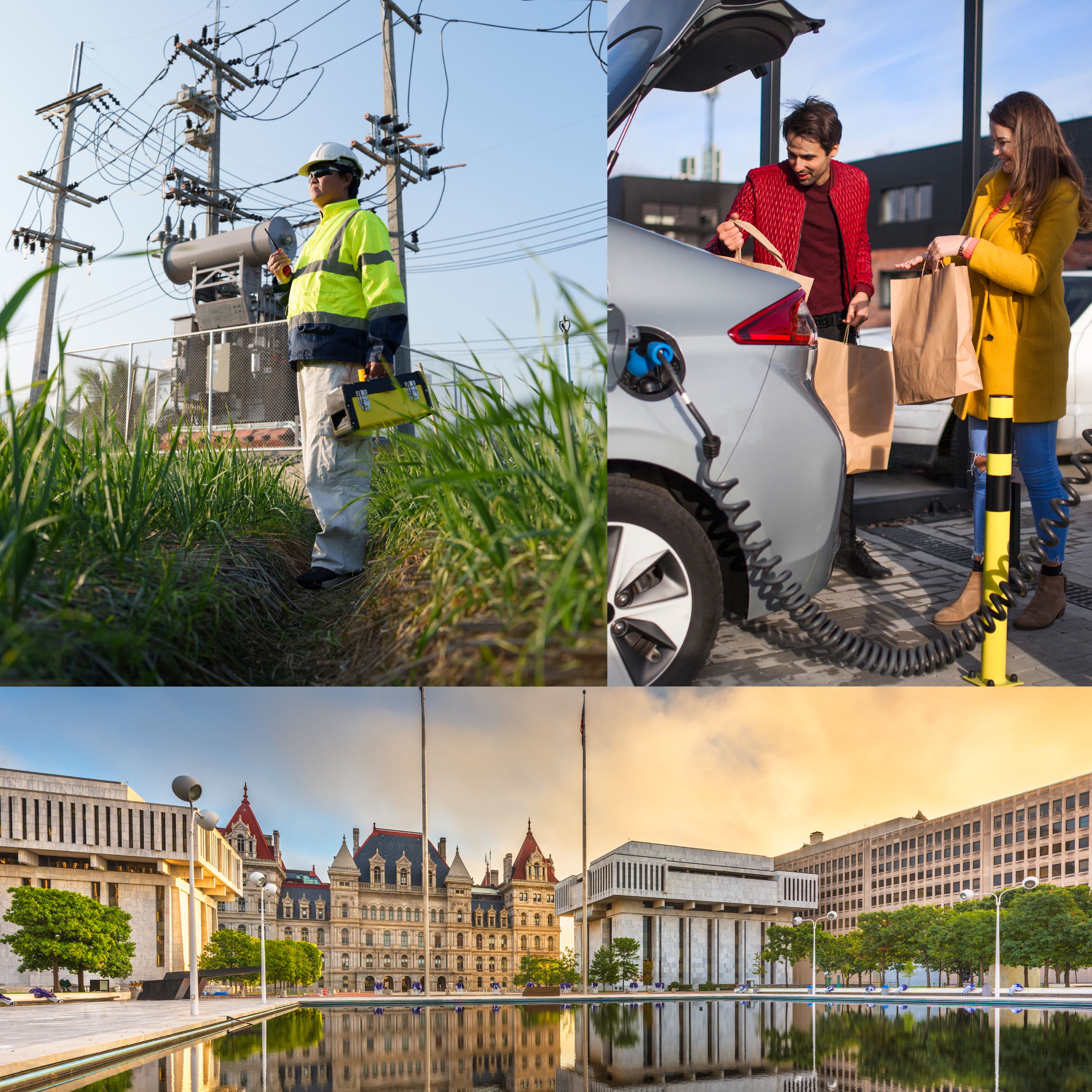
From interstate truck stops to public library parking lots, workers and investors across the country are ready to put more shovels in the ground to deliver EV charging to communities.
Too often, their work is slowed down by funding gaps, costly permitting and interconnection delays, and outdated electricity rate design.
The Energize Coalition works with state governments, industry, utilities, and community organizations to identify and adopt right-sized solutions, innovative policies, and high-impact programs that make EV charging infrastructure more affordable to build, faster to deploy, and cheaper to operate.


Lowering the cost to build via
The funding gap between an empty parking lot and a construction site on its way to becoming a bustling EV charging station can be just a couple thousand dollars. When states and utilities help reduce the cost to build an EV charging station, countless more projects become economically viable from day one.
-
“Make-ready tariffs” can reduce the cost of installing charging infrastructure by roughly 25 percent, by requiring utilities to construct the infrastructure between the meter and grid necessary to energize EV charging as part of the normal course of business. This provides a predictable foundation upon which private and public investments can be made to install chargers.
-
Utilities across the U.S. have EV infrastructure programs and Transportation Electrification Plans totalling $7 billion as of 2026 ($2 billion of which is reserved for underserved communities), which can increase equitable access to charging and expand the reach of EV charging to new places – if spent wisely. Energize works to expand these programs and ensure those dollars are spent effectively.
-
Sources of public support beyond utility programs are needed to spur private investment at a scale commensurate with the challenge. These include tax credits, rebates and grant programs such as the IRA’s 30C tax credit, the Bipartisan Infrastructure Law’s NEVI and CFI programs, and key state programs such as Clean Fleet Enterprise in Colorado, Communities in Charge in California, and commercial building code updates in Minnesota. Energize passes the laws, shapes the regulations, and goes to court to secure and defend these critical programs.
Speeding up deployment and connection via
Chargers can't serve drivers until they're sited, permitted, built, and energized. Cutting red tape, planning ahead, and investing in workforce and community engagement can cut months — or years — from deployment schedules.
-
Lengthy delays in the electrification of EV charging sites are far too common, and they create significant headaches for EV drivers and financial losses for businesses – and even deter some businesses from electrifying their fleets altogether.
-
Proactive planning by utilities that incorporates load forecasting that accurately reflects expected future EV adoption is a key first step to ensuring that chargers aren’t delayed coming online because of an antiquated grid. The next step is ensuring that the utilities act on these plans and, where analysis identifies clear needs, proactively build that needed infrastructure.
-
Beyond planning for where and when grid upgrades will be needed to support EV infrastructure, we also need to ensure that utilities, states and unions are securing and training the workforce necessary to make those upgrades a reality.
-
The deployment of EV infrastructure will proceed more smoothly in the coming years if local communities are involved in the planning and execution of that infrastructure deployment in their communities, and policies and programs that create space for this engagement are critical.
-
Utilities investing at the levels necessary to speed up the deployment of EV infrastructure requires that they can have certainty about their ability to recover appropriate associated costs in a timely manner.
-
Research has shown that cumbersome local permitting processes are one of the main drivers of costly delays in energization timelines. This can be addressed through state legislation and resources, like model ordinances, to help local entities implement streamlined processes.
Lowering the cost to operate via
EV charging is a low-margin business — that means a good charging station is one you can afford to keep running. By taking steps to help keep operating expenses low, states and utilities can enable operators to invest in maintenance, reliability, customer experience, and expansion.
-
Demand charges on traditional commercial & industrial rates can kill the economics of investing in charging. But by better reflecting true underlying costs, utility rates that are designed for high-powered EV charging can meet grid needs while also reducing bills for businesses and fleet owners, increasing fuel cost savings as a result.
-
Most EV charging happens at home, where vehicles are parked for most of the day. Residential rates designed with EVs in mind that reward off-peak charging can deliver the fuel cost savings that are the single biggest motivator of EV purchase decisions. Incentivizing off-peak charging also benefits all utility customers as it reduces grid costs and can actually reduce utility rates.
-
Managing when EVs charge, and using EVs’ batteries to power homes and the grid, creates economic savings and grid security and clean energy benefits, and a combination of policies and incentives are key to maximizing these opportunities.